[:de]
Dem Fachkräftemangel in der Pflege aktiv entgegenwirken
VR-Training wird im Gesundheitswesen bereits genutzt, wird aber hauptsächlich bei der Aus- und Weiterbildung von hoch spezialisierten Fachkräften wie Chirurgen eingesetzt. Warum also diese innovative Lernform nicht auch für andere Fachkräfte zugänglich machen? Genau das tun wir – Mit unserer Anwendung VR Patient Care entsteht ein Prototyp für den Vielversprechenden und unterschätzten Use Case der Ausbildung von Pflegekräften.
Am Puls der Zeit
Das ist unser Mantra für die Zusammenarbeit mit unserem Projekt Partner, den Pflegeschulen Wannsee. Gemeinsam möchten wir den Unterricht nicht nur digitaler, sondern vor allem aktiver gestalten, um eine möglichst praxisnahe und gleichzeitig attraktive Ausbildung anzubieten. Ganz nebenbei steigern wir so die Motivation und regen für nachhaltige Lernerfolge das motorische Gedächtnis an. Zusätzlich zur Festigung der theoretischen Kenntnisse helfen virtuelle Trainingseinheiten auch alltägliche Arbeitsabläufe zu erleben, um so Berührungsängste abzubauen und bestens auf den Umgang mit den Patienten vorbereitet zu sein.
Was uns besonders am Herzen liegt
Inhaltlich starten wir mit einem einfachen, klar umrissenen Thema, dem Pulsmessen. Hier steht vor allem die praktische Anwendung auf dem Lehrplan und dank des VR-Trainings erhält jede*r Schüler*in direktes Feedback ohne eine Eins-zu-eins-Betreuung einer Lehrkraft in Anspruch zunehmen. Dadurch kann umfangreicher und im eigenen Tempo geübt werden, bis jeder Handgriff und das Kopfrechnen perfekt sitzt.
Wir wollen den Lernenden vermitteln, wie man Puls misst und nicht ihren eigenen Puls unnötig in die Höhe treiben. Da unter den Schüler*innen kaum Vorerfahrung mit VR vorhanden ist, achten wir auf eine barrierearme Anwendung und legen unseren Fokus auf eine intuitive und einfache Bedienung.
Für einen niedrigschwelligen Einstieg haben wir viel Herzblut in ein ausführliches Tutorial mit ausreichend Möglichkeit zum Üben und Ausprobieren investiert. So können die Trainees die virtuelle Umgebung und die Steuerung ausgiebig testen, bis sie sich sicher fühlen, um sich im eigentlichen Training voll auf die Aufgaben zu konzentrieren.
Performance on Point, but no Pressure
Die Vitalfunktionen müssen sowohl von der Haptik als auch vom Timing realistisch abgebildet werden, um einen echten Mehrwert zu bieten. Hierfür werden die Pulsschläge mittels Vibrationsfeedback der Controller simuliert, dieses lässt sich zielgenau ansteuern und kann somit täuschend echt den menschlichen Puls nachbilden.
Neben dem Abnehmen des Puls steht die Auswertung der Messwerte im Mittelpunkt. Die Anwendung gibt ein direktes Feedback, ob die errechneten Werte stimmen bzw. wie weit sie vom tatsächlichen Puls abweichen.
Für die unkomplizierte und kosteneffiziente Nutzung setzten wir auch bei diesem Training auf Stand-Alone-Headsets und passen die grafische Darstellung an die limitierte Performance an. So entsteht ein minimalistischer, aber überzeugenden Art-Style, der keine Gefahr läuft, das Limit der VR-Brille zu überschreiten oder von den Lehrinhalten ablenkt.
Auch bei diesem Projekt greifen wir auf die Expertise unseres Hardwarepartners Schenker Technologies zurück, der neben der Beratung zum passenden Device ein umfangreiches Gesamtpaket mit einem Klassensatz an VR-Brillen samt Aufbewahrungslösung schnürt.
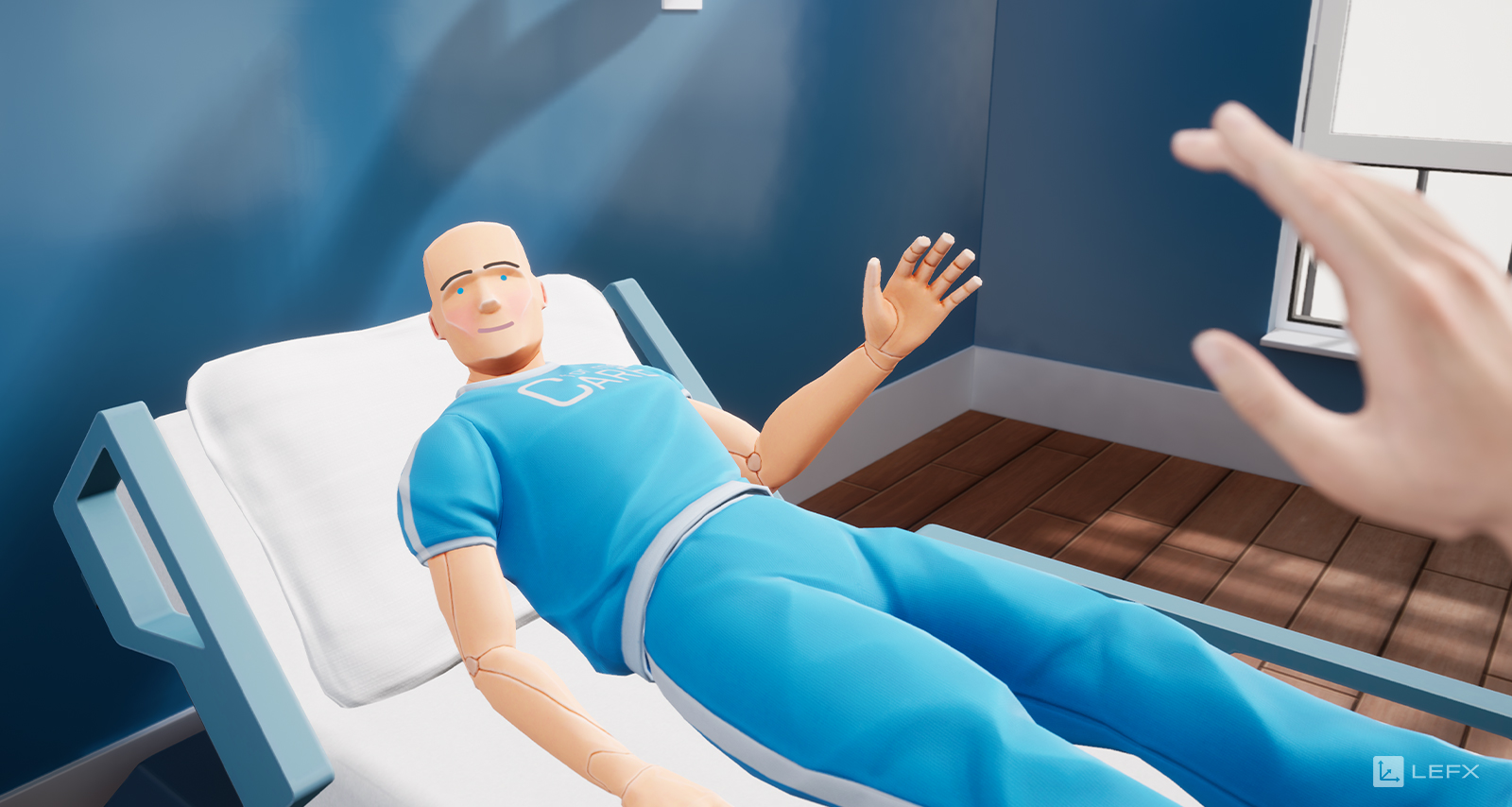
Die Anwendung lässt nicht nur das Herz unseres Kunden höherschlagen
Neben dem Schulungszentrum bekommen wir vor allem von den Schüler*innen sehr positives Feedback und Anregungen für die geplante Erweiterung:
Wir starten mit mehr Varianz bei den Patienten, um auch Kinder mit einer schnelleren Herzfrequenz oder Menschen mit Herzrhythmusstörungen abzubilden. Darüber hinaus wird der Patient aktiver und, es muss mehr mit ihm und weiteren Störfaktoren im Raum interagiert werden. Damit die Theorie nicht zu kurz kommt, werden auch regelmäßig Multiple-Choice-Fragen, die Fachwissen oder situationsbezogene Handlungen abfragen, eingebunden. Kurz gesagt: wir schaffen ein möglichst realistisches Alltags-Szenario, in dem die Trainees auf ihren herausfordernden Arbeitsalltag bestens vorbereitet werden.
Unser Ziel ist auch, das Portfolio langfristig durch weitere Lehrinhalte und komplexere Szenarien zu erweitern, um so einen Großteil der Ausbildung praxisnah und digital zu gestalten.
[:en]
Actively counteracting the shortage of skilled nursing staff
VR training is already being used in healthcare, but it is mainly used in the education and training of highly specialized professionals such as surgeons. So why not make this innovative form of learning accessible to other professionals? That’s exactly what we are doing – With our VR Patient Care application, we are creating a prototype for the promising and underestimated use case of training nurses.
On the pulse of time
This is our mantra for the cooperation with our project partner, the Pflegeschulen Wannsee. Together, we want to make teaching not only more digital, but above all more active, in order to offer training that is as practical and attractive as possible. As a side effect, we increase motivation and stimulate motor memory for sustainable learning success. In addition to consolidating theoretical knowledge, virtual training units also help students to experience everyday work processes in order to overcome fears of contact and to be optimally prepared for dealing with patients.
What is particularly close to our hearts
In terms of content, we start with a simple, clearly defined topic, pulse measurement. Here, the focus is on practical application, and thanks to VR training, each student receives direct feedback without the need for one-on-one supervision by a teacher. This allows students to practice more extensively and at their own pace until every move and mental arithmetic is perfect.
We want to teach the learners how to take their pulse and not to raise their own pulse unnecessarily. Since there is hardly any previous experience with VR among the students, we make sure that the application is low barrier and focus on intuitive and simple operation.
For a low-threshold entry, we have invested a lot of heart and soul in a detailed tutorial with sufficient opportunity to practice and try it out. This allows trainees to test the virtual environment and controls extensively until they feel confident so that they can concentrate fully on the tasks in the actual training.
Performance on Point, but no Pressure
The vital functions must be reproduced realistically in terms of both haptics and timing in order to offer real added value. For this purpose, the pulse beats are simulated by means of vibration feedback from the controller, which can be controlled precisely and can thus deceptively simulate the human pulse.
In addition to taking the pulse, the focus is on evaluating the measured values. The application provides direct feedback as to whether the calculated values are correct or how far they deviate from the actual pulse.
For uncomplicated and cost-efficient use, we also relied on stand-alone headsets for this training and adapted the graphic display to the limited performance. This results in a minimalistic but compelling art style that doesn’t run the risk of exceeding the limit of the VR goggles or distracting from the instructional content.
For this project, we also draw on the expertise of our hardware partner Schenker Technologies, who, in addition to advising on the appropriate device, put together a comprehensive overall package with a class set of VR glasses including a storage solution.
The application not only makes our customer’s heart beat faster
In addition to the training center, we are getting very positive feedback and suggestions for the planned expansion, especially from the students:
We start with more variance in the patients to also map children with a faster heart rate or people with cardiac arrhythmias. In addition, the patient will be more active and more interaction with him and other disturbing factors in the room will be required. To ensure that theory is not neglected, multiple-choice questions that test specialist knowledge or situational actions are also regularly included. In short, we create an everyday scenario that is as realistic as possible, in which the trainees are ideally prepared for their challenging day-to-day work.
Our goal is also to expand the portfolio in the long term with additional teaching content and more complex scenarios, so that a large part of the training is practical and digital.
[:]