
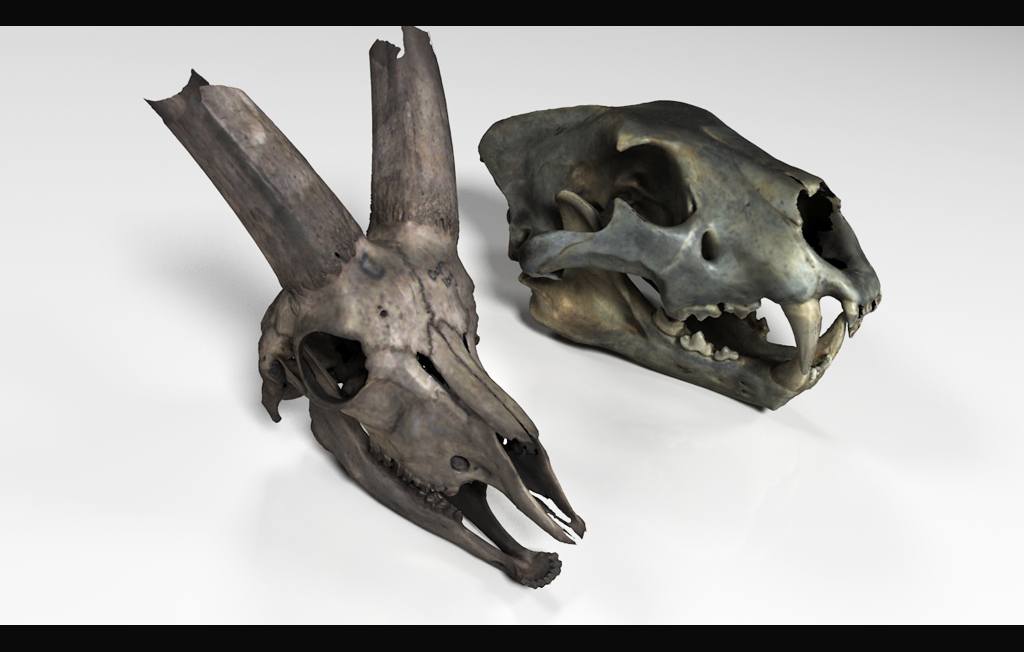
[:de]Über eine Laufzeit von 4 Jahren wurden für das Max Planck Institut Knochen von menschlichen und tierischen Skeletten gescannt, weiterverarbeitet und für eine Datenbank exportiert. Eingebettet in 3D-PDF’s werden diese 3D-Modell-Knochen Archäologen und Anthropologen in der ganzen Welt zur Verfügung gestellt.
Der Vorteil von 3D-PDF’s besteht darin, dass Objekte, durch Drehen und Zoomen, aus allen Perspektiven und Abständen betrachtet und vermessen werden können. Im Sinne des Schutzes der Objekte müssen diese dafür nicht mehr physikalisch vorhanden sein.
Durch den Einsatz eines Lichtzeltes war es möglich, alle Bereiche des Knochens gleichmäßig auszuleuchten. Dank verbesserter Scan-Technik konnte ein Knochen innerhalb von 30 Minuten in erhöhter Qualität komplett bearbeitet werden.
Für weitere Informationen bzgl. der Scan-Technik und deren Optimierung empfehlen wir folgende Lektüre, die in Zusammenarbeit mit dem Max Planck Institut entstanden ist:
Veröffentlichung im „Journal of Archaeological Science“:
Niven, L., T. E. Steele, H. Finke, T. Gernat, J.-J. Hublin, “Virtual skeletons: using a structured light scanner to create a 3D faunal comparative collection.” Journal of Archaeological Science 36: 2018- 2023.[:en]During a runtime of 4 years (1 year of further development of the scanning environment and 3 years of scanning), human and animal bones were scanned, edited and exported for a database of the Max Planck Institute for Evolutionary Anthropology in Leipzig/Germany. The goal was to make these scanned bones freely available for archaeologists and anthropologists worldwide as 3D models embedded in 3D PDF files.
The advantage of 3D PDFs is that users are able to see and measure the objects from all perspectives and distances by turning and zooming in, while these do not have to be physically present and thus avoiding unnecessary signs of wear and tear.
In preparation of the scanning it was necessary to improve the workflow of the scanner (model triTOS TT811 from the company Brueckmann) as oftentimes black borders were seen on the objects, for example. With the help of a light tent which allowed to direct the same amount of light to all areas of the bone, the objects now appeared free of fragments or flaws.
Another advantage are the scanning and editing times necessary per bone. Originally, it took two hours to receive a lower-quality result. Afterwards, the bones could be completely processed within 30 minutes (on average) resulting in an image of higher quality.
The improvements due to new programs and the light tent have been published in an English-speaking article for an internationally recognized archeology magazine:
Niven, L., T. E. Steele, H. Finke, T. Gernat, J.-J. Hublin, „Virtual skeletons: using a structured light scanner to create a 3D faunal comparative collection.“ Journal of Archaeological Science 36: 2018-2023.[:]
![[:de]Exposé 3D-Daten[:en]Exposé 3D-Data[:]](https://test.lefx.de/wp-content/uploads/2015/11/Vorschaubild_expose.png)
![[:de]LOFT[:en]LOFT[:]](https://test.lefx.de/wp-content/uploads/2016/03/Beitragsbild_loft-1024x633.jpg)